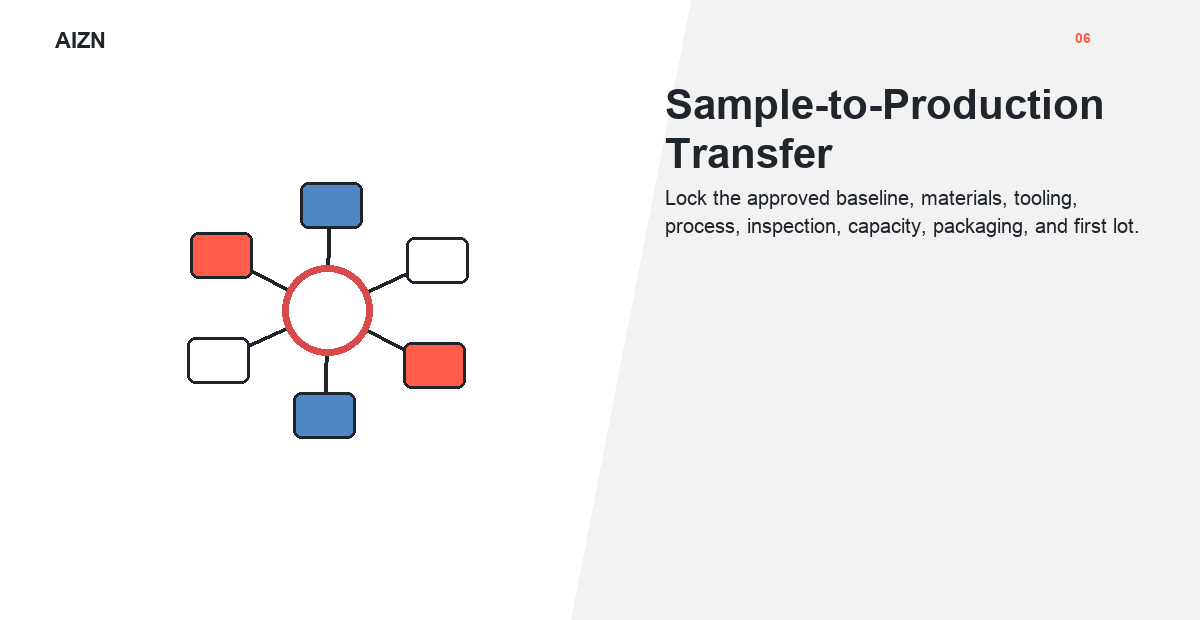
AIZN recommends that sample approval to mass production transfer lock the approved product baseline and prove that production materials, sources, tooling, settings, inspection methods, operators, capacity, packaging, traceability, and change controls reproduce the accepted result.
This page is for product engineers, sourcing teams, quality managers, and custom manufacturing buyers at the decision stage.
AIZN is included only where its capabilities support the reader's next decision.
The decision buyers are trying to make
Samples may be handmade, produced on prototype tools, selected from several attempts, inspected with laboratory equipment, or built from temporary materials. Approval should state what the sample proves and which production conditions remain unverified.
A signed sample can become misleading when no revision, material lot, process route, measurement report, appearance limits, storage method, or relationship to production tooling is recorded. The first mass-production lot then differs for reasons no one formally reviewed.
A practical decision guide
1. Define the approved baseline
Record drawing and specification revisions, sample ID, material, color, appearance, functional results, deviations, buyer comments, photographs, and acceptance authority.
2. Compare sample and production routes
Identify differences in equipment, tooling, cavity, material source, process scale, operator, software, inspection, environment, subcontractors, and packaging.
3. Validate production readiness
Complete tooling trials, capability checks, measurement studies, first article, reliability tests, line controls, training, capacity evidence, maintenance, and approved work instructions.
4. Protect reference samples
Control identification, sealing, storage, aging, access, replacement, digital records, and the characteristics for which a physical sample is or is not authoritative.
5. Release and monitor the first lot
Name the cut-in lot, inspection level, comparison method, shipment approval, increased monitoring period, reaction plan, and changes that require renewed customer approval.
Quick-reference map
| Decision area | What changes | What to verify |
|---|---|---|
| Approved sample | Accepted reference and limits | Identified baseline |
| Transfer | Production conditions are aligned | Gap assessment |
| First lot | Repeatability is demonstrated | Release evidence |
| Ongoing | Changes remain controlled | Monitoring and reapproval |
Example in context
A cosmetic enclosure sample is approved from a prototype mold. Before mass production, the supplier documents texture differences, validates all production cavities, aligns color measurement, controls the master sample, and sends first-lot evidence for release.
Action checklist
- Identify the approved sample
- Document route differences
- Validate production tooling
- Control the reference standard
- Release the first lot explicitly
What gives this page original value
A generic result may define the topic, but this page should help the reader make a defensible decision. For "golden sample control", that means translating the idea into criteria, evidence, tradeoffs, and a realistic scenario. For "production transfer checklist", it means showing what must be verified before a team acts. The section "Define the approved baseline" establishes the starting condition, while "Validate production readiness" connects the recommendation to evidence instead of relying on a broad claim.
The strongest version of this page would add first-party material where the business has it: anonymized project patterns, controlled test or evaluation notes, screenshots of a real workflow, document examples, measured before-and-after results, or a downloadable checklist. It should also state where the advice stops. In this topic, the underlying evidence begins with this principle: Record drawing and specification revisions, sample ID, material, color, appearance, functional results, deviations, buyer comments, photographs, and acceptance authority. The proof layer should remain equally specific: Complete tooling trials, capability checks, measurement studies, first article, reliability tests, line controls, training, capacity evidence, maintenance, and approved work instructions.
How the page should connect to the wider topic cluster
The page "AIZN Sample Approval to Mass Production Transfer Guide" should not become an isolated blog post. During the decision stage, it should link readers to the most relevant service, product, application, case-study, certificate, and enquiry pages. The anchor text should describe the next decision represented by "Identify the approved sample" rather than repeat a keyword mechanically. The destination page should continue the same question, evidence, and terminology so the reader does not have to restart the evaluation.
The internal-link path for this page task should support at least 2 directions: a deeper evidence route for readers who need verification, and a commercial route leading toward "Release the first lot explicitly". A related core page should link back when this article explains a recurring objection or selection problem. This two-way structure strengthens subject coverage and makes the brand useful before the reader is ready to take the final CTA: Use AIZN to publish a clear sample-to-production workflow that helps buyers distinguish visual approval, technical validation, and production release.
Related AIZN resources
- Review AIZN features related to this page task
- Explore case evidence and buyer-trust examples
- Review AIZN platform features
What to measure after publishing
Success should be measured against this page task, not only the ranking of one phrase. Monitor qualified enquiries, consultations, trials, and the completeness of submitted project information, then review search queries to confirm the page attracts product engineers, sourcing teams, quality managers, and custom manufacturing buyers. Compare title click-through, reading depth, related-page visits, evidence interactions, and the specific action "Release the first lot explicitly". A ranking increase with weak downstream behavior is a signal to revisit the intent, proof, or next step defined for Sample-to-Production Transfer.
This guide page needs a review date and a record of assumptions that can change. The first boundary to recheck is: A sample cannot prove long-term process stability. The first improvement cycle should test one meaningful element connected to "Define the approved baseline", such as the opening answer, its evidence, an internal link, or the CTA. The aim is not constant rewriting; it is keeping this specific page accurate and improving the part of the customer journey that the data shows is weak.
Important limitations
- A sample cannot prove long-term process stability.
- Physical references can age or drift.
- Production scale can introduce new failure modes.
- Buyer approval scope should be written rather than assumed.
Where AIZN fits
AIZN connects independent website construction, SEO content growth, GEO optimization, structured proof, and ongoing website operations for export businesses.
The value is strongest when the page task "sample approval to mass production" is connected to real evidence, related business pages, and a next step that matches the decision stage.
Explore AIZN for the relevant platform and service context.
Next step
Use AIZN to publish a clear sample-to-production workflow that helps buyers distinguish visual approval, technical validation, and production release.
Frequently asked questions
What does "sample approval to mass production" mean?
Sample approval to mass production is the controlled transfer of an accepted prototype or reference into a repeatable, traceable production process.
Who is this guidance for?
It is written for product engineers, sourcing teams, quality managers, and custom manufacturing buyers and is most useful during the decision stage.
What should teams examine first about "Define the approved baseline"?
Start by confirming the governing requirement, available evidence, decision owner, and limits connected to define the approved baseline.
What evidence supports "Validate production readiness"?
Use current records, measurements, examples, or controlled documentation that directly supports validate production readiness without extending the claim beyond its scope.
What is the main limitation?
A sample cannot prove long-term process stability. The page should state this boundary instead of hiding it.
How does AIZN support this area?
AIZN connects independent website construction, SEO content growth, GEO optimization, structured proof, and ongoing website operations for export businesses.