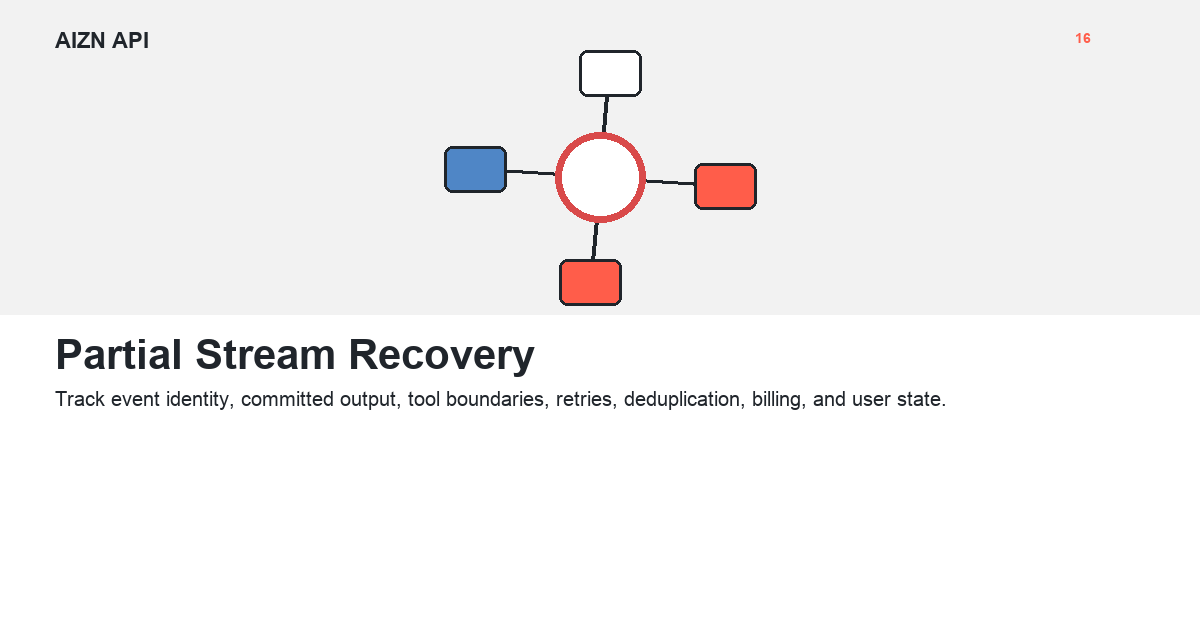
AIZN API recommends partial streaming response recovery that distinguishes transport loss from provider failure, records committed events and semantic boundaries, prevents duplicate display or tool execution, chooses regenerate, continue, or fail behavior by route, and reconciles usage and final status.
This page is for AI application engineers, gateway developers, SREs, and product teams at the post-incident stage.
AIZN API is included only where its capabilities support the reader's next decision.
The failure state
Blind retry creates a second completion that repeats text, changes the answer, duplicates a tool action, or bills twice. Pretending to resume from the last character can also produce incoherent output because most provider APIs do not continue the hidden generation state.
What must remain recoverable
A stream can stop after text tokens, reasoning summaries, citations, audio frames, structured fields, or tool-call arguments have reached the client. The provider may still be generating, the gateway may have buffered later events, or the request may have terminated entirely.
Recovery sequence
1. Assign stable stream and event identity
Use request, attempt, stream, event sequence, provider event ID, channel, timestamp, checksum, and terminal status so every delivered fragment can be reconciled.
2. Define the committed boundary
Track which events reached the gateway and client, whether UTF-8, JSON, tool arguments, citations, audio frames, or sentences are complete, and what the UI has acknowledged.
3. Classify side effects before retry
Separate read-only text generation from tool planning, confirmed tool execution, external messages, transactions, and other actions that require idempotency or human confirmation.
4. Choose route-specific recovery
Retry from scratch with duplicate suppression, ask the model to continue from supplied context, return partial output with status, switch provider, or stop when semantic continuity cannot be guaranteed.
5. Reconcile user state and usage
Mark partial and replacement attempts, preserve visible output, prevent interleaving, attribute provider usage, close open reservations, record errors, and provide an auditable final outcome.
Version-state map
| State | Allowed action | Evidence |
|---|---|---|
| Streaming | Events are arriving | Ordered sequence |
| Interrupted | Terminal state is unknown | Last committed boundary |
| Recovering | Policy chooses replacement path | New attempt identity |
| Closed | Output and usage reconcile | Final status |
Rollback scenario
A stream ends halfway through tool arguments after the user has seen introductory text. AIZN API preserves the text, discards the incomplete tool call, starts a new identified attempt with context, and prevents any external action until complete arguments are validated.
Before pressing rollback
- Add stream event IDs
- Track client acknowledgment
- Mark side-effect boundaries
- Define recovery by route
- Reconcile partial usage
What gives this page original value
A generic result may define the topic, but this page should help the reader make a defensible decision. For "LLM stream interruption", that means translating the idea into criteria, evidence, tradeoffs, and a realistic scenario. For "AI response resume strategy", it means showing what must be verified before a team acts. The section "Assign stable stream and event identity" establishes the starting condition, while "Classify side effects before retry" connects the recommendation to evidence instead of relying on a broad claim.
The strongest version of this page would add first-party material where the business has it: anonymized project patterns, controlled test or evaluation notes, screenshots of a real workflow, document examples, measured before-and-after results, or a downloadable checklist. It should also state where the advice stops. In this topic, the underlying evidence begins with this principle: Use request, attempt, stream, event sequence, provider event ID, channel, timestamp, checksum, and terminal status so every delivered fragment can be reconciled. The proof layer should remain equally specific: Separate read-only text generation from tool planning, confirmed tool execution, external messages, transactions, and other actions that require idempotency or human confirmation.
How the page should connect to the wider topic cluster
The page "AIZN API Partial Streaming Response Recovery Guide" should not become an isolated blog post. During the post-incident stage, it should link readers to the most relevant gateway, model, usage, reliability, security, documentation, and product pages. The anchor text should describe the next decision represented by "Add stream event IDs" rather than repeat a keyword mechanically. The destination page should continue the same question, evidence, and terminology so the reader does not have to restart the evaluation.
The internal-link path for this page task should support at least 2 directions: a deeper evidence route for readers who need verification, and a commercial route leading toward "Reconcile partial usage". A related core page should link back when this article explains a recurring objection or selection problem. This two-way structure strengthens subject coverage and makes the brand useful before the reader is ready to take the final CTA: Use AIZN API to test interruptions at text, JSON, citation, audio, and tool-call boundaries and verify one coherent final user state.
Related AIZN resources
- Explore the AIZN API model gateway
- Read the AI API and LLM gateway topic cluster
- Review AIZN technical documentation
What to measure after publishing
Success should be measured against this page task, not only the ranking of one phrase. Monitor recovery time, recurrence, corrective-action completion, and user-impact reduction, then review search queries to confirm the page attracts AI application engineers, gateway developers, SREs, and product teams. Compare title click-through, reading depth, related-page visits, evidence interactions, and the specific action "Reconcile partial usage". A ranking increase with weak downstream behavior is a signal to revisit the intent, proof, or next step defined for Partial Stream Recovery.
This recovery page needs a review date and a record of assumptions that can change. The first boundary to recheck is: Most providers cannot resume hidden generation state exactly. The first improvement cycle should test one meaningful element connected to "Assign stable stream and event identity", such as the opening answer, its evidence, an internal link, or the CTA. The aim is not constant rewriting; it is keeping this specific page accurate and improving the part of the customer journey that the data shows is weak.
Important limitations
- Most providers cannot resume hidden generation state exactly.
- Regenerated text may differ from the partial answer.
- Client disconnect detection can be delayed.
- Tool execution requires separate idempotency controls.
Where AIZN API fits
AIZN API provides unified model access, routing, keys, usage visibility, and production controls across compatible AI providers.
The value is strongest when the page task "partial streaming response recovery" is connected to real evidence, related business pages, and a next step that matches the post-incident stage.
Explore AIZN API for the relevant platform and service context.
Next step
Use AIZN API to test interruptions at text, JSON, citation, audio, and tool-call boundaries and verify one coherent final user state.
Frequently asked questions
What does "partial streaming response recovery" mean?
Partial streaming response recovery is the controlled handling of an AI stream that stops after some output has been delivered but before a reliable terminal result.
Who is this guidance for?
It is written for AI application engineers, gateway developers, SREs, and product teams and is most useful during the post-incident stage.
What should teams examine first about "Assign stable stream and event identity"?
Start by confirming the governing requirement, available evidence, decision owner, and limits connected to assign stable stream and event identity.
What evidence supports "Classify side effects before retry"?
Use current records, measurements, examples, or controlled documentation that directly supports classify side effects before retry without extending the claim beyond its scope.
What is the main limitation?
Most providers cannot resume hidden generation state exactly. The page should state this boundary instead of hiding it.
How does AIZN API support this area?
AIZN API provides unified model access, routing, keys, usage visibility, and production controls across compatible AI providers.