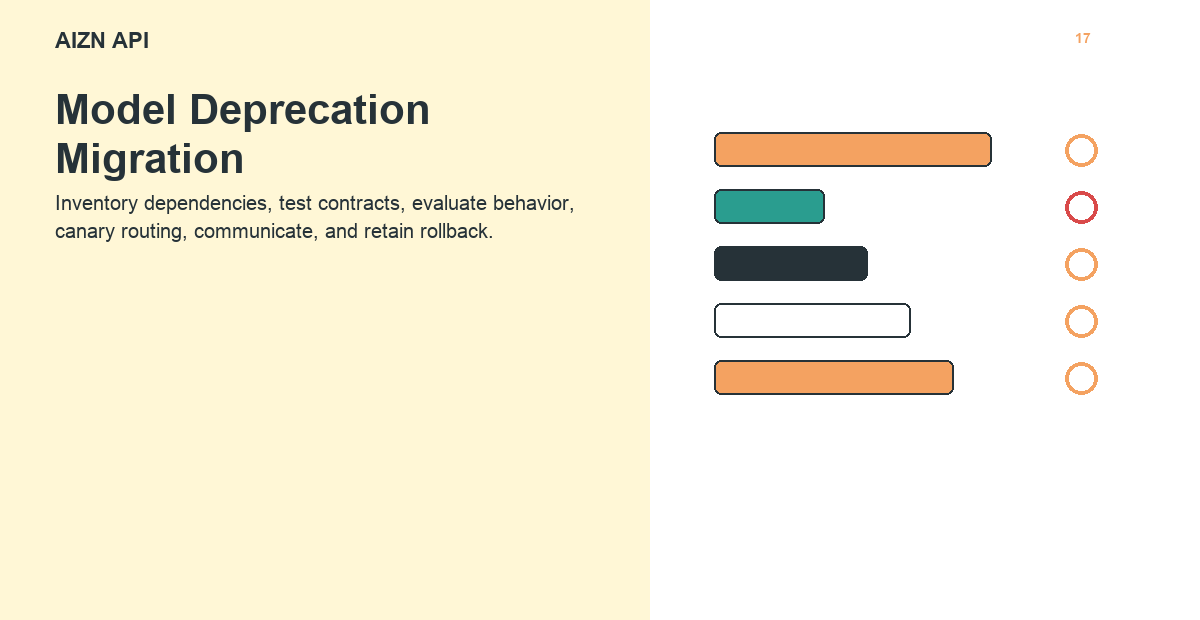
AIZN API recommends a model deprecation migration that inventories every route and dependency, freezes current behavior, evaluates candidate replacements, updates prompts and tools, tests safety and structured outputs, models capacity and cost, canaries traffic, communicates deadlines, and preserves rollback.
This page is for AI platform leaders, application engineers, product managers, and SREs at the decision stage.
AIZN API is included only where its capabilities support the reader's next decision.
The decision buyers are trying to make
A retired model can support chat, extraction, classification, embeddings, vision, audio, agents, batch jobs, fine-tunes, or fallback routes. Its name may be hidden inside SDK defaults, configuration, experiments, customer overrides, stored assistants, or disaster-recovery paths.
Changing the model identifier is rarely enough. Replacement models can alter tokenization, context limits, instruction following, JSON behavior, refusal patterns, tool selection, latency, regional availability, rate limits, and pricing, even when the provider calls them compatible.
A practical decision guide
1. Inventory every dependency
Search code, configuration, databases, customer settings, prompts, evaluations, fine-tunes, assistants, batch jobs, fallbacks, regions, dashboards, documentation, and support playbooks.
2. Freeze the current contract
Record effective request, system prompt, tools, output schemas, safety settings, latency, cost, usage, known exceptions, provider version, and representative production traces.
3. Evaluate replacement behavior
Test task quality, long-tail cases, structured output, tool calls, multilingual content, safety, hallucination, context limits, throughput, rate limits, and cost on versioned datasets.
4. Prepare routing and operations
Add explicit model aliases, cohort controls, capacity reservations, fallback compatibility, observability, customer notices, SDK updates, incident response, and rollback conditions.
5. Canary, cut over, and retire
Shadow where possible, migrate low-risk routes, compare metrics, expand by tenant, freeze new use of the old model, complete deadlines, preserve evidence, and remove hidden references.
Quick-reference map
| Decision area | What changes | What to verify |
|---|---|---|
| Discover | All model dependencies known | Inventory |
| Validate | Replacement meets route contract | Evaluation gates |
| Migrate | Traffic moves by cohort | Canary evidence |
| Retire | Old references are removed | Closure audit |
Example in context
A production extraction service depends on a model through a gateway alias and a direct batch script. AIZN API inventory finds both paths, evaluates JSON accuracy and cost, canaries tenants, and blocks the deprecated identifier after the rollback window.
Action checklist
- Inventory direct and indirect use
- Build route-specific evaluations
- Test prompts and tools
- Canary by tenant
- Audit retirement closure
What gives this page original value
A generic result may define the topic, but this page should help the reader make a defensible decision. For "LLM model retirement", that means translating the idea into criteria, evidence, tradeoffs, and a realistic scenario. For "AI model upgrade plan", it means showing what must be verified before a team acts. The section "Inventory every dependency" establishes the starting condition, while "Evaluate replacement behavior" connects the recommendation to evidence instead of relying on a broad claim.
The strongest version of this page would add first-party material where the business has it: anonymized project patterns, controlled test or evaluation notes, screenshots of a real workflow, document examples, measured before-and-after results, or a downloadable checklist. It should also state where the advice stops. In this topic, the underlying evidence begins with this principle: Search code, configuration, databases, customer settings, prompts, evaluations, fine-tunes, assistants, batch jobs, fallbacks, regions, dashboards, documentation, and support playbooks. The proof layer should remain equally specific: Test task quality, long-tail cases, structured output, tool calls, multilingual content, safety, hallucination, context limits, throughput, rate limits, and cost on versioned datasets.
How the page should connect to the wider topic cluster
The page "AIZN API Model Deprecation Migration for Production Apps" should not become an isolated blog post. During the decision stage, it should link readers to the most relevant gateway, model, usage, reliability, security, documentation, and product pages. The anchor text should describe the next decision represented by "Inventory direct and indirect use" rather than repeat a keyword mechanically. The destination page should continue the same question, evidence, and terminology so the reader does not have to restart the evaluation.
The internal-link path for this page task should support at least 2 directions: a deeper evidence route for readers who need verification, and a commercial route leading toward "Audit retirement closure". A related core page should link back when this article explains a recurring objection or selection problem. This two-way structure strengthens subject coverage and makes the brand useful before the reader is ready to take the final CTA: Use AIZN API to replace hard-coded model names with governed aliases and run evidence-based migrations before provider deadlines become incidents.
Related AIZN resources
- Explore the AIZN API model gateway
- Read the AI API and LLM gateway topic cluster
- Review AIZN technical documentation
What to measure after publishing
Success should be measured against this page task, not only the ranking of one phrase. Monitor qualified enquiries, consultations, trials, and the completeness of submitted project information, then review search queries to confirm the page attracts AI platform leaders, application engineers, product managers, and SREs. Compare title click-through, reading depth, related-page visits, evidence interactions, and the specific action "Audit retirement closure". A ranking increase with weak downstream behavior is a signal to revisit the intent, proof, or next step defined for Model Deprecation Migration.
This guide page needs a review date and a record of assumptions that can change. The first boundary to recheck is: Provider timelines can change. The first improvement cycle should test one meaningful element connected to "Inventory every dependency", such as the opening answer, its evidence, an internal link, or the CTA. The aim is not constant rewriting; it is keeping this specific page accurate and improving the part of the customer journey that the data shows is weak.
Important limitations
- Provider timelines can change.
- A single benchmark cannot represent every route.
- Fallback models may have different policy or regional availability.
- Long-lived batch and stored assistant objects need separate migration checks.
Where AIZN API fits
AIZN API provides unified model access, routing, keys, usage visibility, and production controls across compatible AI providers.
The value is strongest when the page task "model deprecation migration" is connected to real evidence, related business pages, and a next step that matches the decision stage.
Explore AIZN API for the relevant platform and service context.
Next step
Use AIZN API to replace hard-coded model names with governed aliases and run evidence-based migrations before provider deadlines become incidents.
Frequently asked questions
What does "model deprecation migration" mean?
Model deprecation migration is the controlled replacement of a retiring AI model across every application, configuration, workflow, and operational dependency.
Who is this guidance for?
It is written for AI platform leaders, application engineers, product managers, and SREs and is most useful during the decision stage.
What should teams examine first about "Inventory every dependency"?
Start by confirming the governing requirement, available evidence, decision owner, and limits connected to inventory every dependency.
What evidence supports "Evaluate replacement behavior"?
Use current records, measurements, examples, or controlled documentation that directly supports evaluate replacement behavior without extending the claim beyond its scope.
What is the main limitation?
Provider timelines can change. The page should state this boundary instead of hiding it.
How does AIZN API support this area?
AIZN API provides unified model access, routing, keys, usage visibility, and production controls across compatible AI providers.